
The woman who would become the last Queen of Italy, the “May Queen” was born HRH
Princess Marie Jose Charlotte Sophie Amelie Henriette Gabrielle of
Saxe-Coburg-Gotha on August 4, 1906 in Ostend to Their Majesties King Albert I
of Belgium and Queen Elisabeth, Duchess of Bavaria, the youngest of three
children born to the Belgian royal couple. To a large extent, much of the course
of her life was set by the German invasion of Belgium in 1914 at the start of
the First World War. Princess Marie-Jose, only eight-years-old at the time, was
sent to school in the relative safety of England while her parents stayed at the
front where the Belgian army tenaciously held on to the last unconquered corner
of their country. The little princess would regularly go and visit and her
parents, while careful of her safety, made no effort to shield the little
princess from the hard facts of reality. Even at the age of 12 she was helping
her mother the Queen in the field hospital making bandages for the wounded
soldiers. The war impacted Princess Marie-Jose in a number of ways. It cemented
her idolization of her father as the heroic King who stood firm for the
independence of his country in the face of overwhelming odds, it embedded in her
a lifelong distrust of Germany and it narrowed the possibilities for who her
future husband might be. Belgium and Italy were the only Catholic monarchies on
the Allied side and, after the war, about the only Catholic kingdoms left at
all. So, while she was still very young it was decided that the Princess would
one day marry the Savoy heir-to-the-throne HRH Prince Umberto of
Piedmont.

World War I, and all the
horrors and ugliness associated with it, may also have helped instill in
Princess Marie-Jose a greater love for the opposite; for beauty, beautiful art,
beautiful music, for a more liberal world and a total aversion to conflict and
bloodshed. With the course of her life set before her, she looked toward the
future hoping for the best. The Prince of Piedmont was already known as one of
the most handsome young royals in Europe and as Princess Marie Jose grew up she
developed a rather unrealistic expectation of the Savoy heir as the perfect
prince charming, an image encouraged by those around her. In fact, the two had
vastly different backgrounds and upbringings. Princess Marie Jose loved to play
with her father as a child and, particularly through the influence of her
mother, was given a very liberal education, an appreciation for simplicity,
tolerance and new ideas. Prince Umberto, on the other hand, was raised to be a
soldier, given a military education, had the glorious family history of the
House of Savoy stressed upon him and his duty to carry on that illustrious
legacy. Interactions with family were kind but correct and it had not be so long
ago that royal children were still required to bow in the presence of their
father the King and address him by his royal title. Things were not quite that
formal for Umberto but undoubtedly the history, forms and grandeur of the
monarchy were stressed much more heavily in Rome than in Brussels. The princess
was an informal girl who very much ‘marched to the beat of a different drummer’.
When thinking of Italy she most likely envisioned the romantic aspects; the art,
the music and the way the ordinary people loved life. She was probably not quite
so prepared for the orderly, regimented court and elaborate ceremony of the
Savoy monarchy.
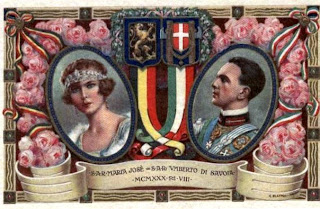
The time finally came on January 8, 1930 when the
glamorous Belgian Princess was married, in Rome, to her tall and dashing Italian
prince. It was a lavish, colorful ceremony, planned to awe and inspire but it
was something of an ordeal for the new Princess of Piedmont. She would have
preferred something simpler but Prince Umberto, fastidious himself, was
determined that the ‘look’ of the event would be one all Italians would always
remember. The new couple did have some things in common. They were devoted
Catholics, they dreamed of a glorious future for the Italian people and they
were both compassionate and good-hearted individuals. Aside from that, there
were not many things they shared. For Princess Marie-Jose, the vibrant, outgoing
free spirit, there was also the fact that she had married into the Italian Royal
Family during the Fascist era and with her background, attitude and character,
she clashed with the brutish dictator from the very start. Mussolini disliked
everything about her, from the way she spelled her own name (she refused to
convert to the Italian version out of nationalism) to how she dressed (Fascists
preferred a more dour and matronly appearance) and he certainly didn’t like her
ideas on freedom, tolerance and the sort of liberal, artistic people she
surrounded herself with. Of course, Princess Marie Jose was just as repelled by
everything Mussolini stood for, be it his bombastic, crude manners, his love of
war or his fawning friendship with Germany.

Because of this, Princess
Marie Jose was not to have the wedded life of her dreams. Her unconventional
ways were hard for the Italian Royal Family or her husband to understand and the
Fascist press took every opportunity to criticize her and the Prince of Piedmont
as well since they regarded him as being insufficiently supportive of the
Fascist Party as well. One thing Princess Marie Jose did have in common with her
husband was a sincere Catholic faith. She visited St Padre Pio and was very
supportive of Church endeavors. Her fashionable ways made her a trend-setter in
Roman society, which infuriated the Fascists who did everything they could to
smear her reputation. Because no children were immediately forthcoming they
accused the Princess of being cold, immoral and having only a “show” marriage.
This, of course, was not true and the Prince and Princess of Piedmont eventually
had four children. They mocked the Princess for her appearance, accusing her of
being unattractive and the absurdity of that can be seen by all simply by
looking at her photographs. All of this had to be done subtly and “unofficially”
of course because the Italians would not stand for attacks on the Royal Family
but the ugly stories the Fascists put out worked their way into society. The
Princess was accused of being a “traitor” to Italy when in fact she only opposed
the Fascist regime and their aggression. She was always supportive of Italy and
always supported the Italian troops that were sent off to war.

Princess
Marie Jose served as President of the Italian Red Cross after 1939 and was
greatly alarmed by the outbreak of World War II. According to Count Ciano (who
also opposed the German alliance) he promised and did tell her when he first he
learned of the German plan to invade Belgium so that she might warn her brother
King Leopold III, though it did little good. When Italy joined the war, the
Princess of Piedmont joined the Queen and other royal ladies in working
tirelessly to nurse the wounded and frostbitten soldiers from the front where
Prince Umberto held nominal command over the forces that invaded France. Never
lacking in courage, she even tried to intervene with Adolf Hitler to obtain the
release of Belgian prisoners of war. Showing no lack of devotion to the Italian
troops either, Princess Marie Jose nonetheless cultivated her contacts with
liberals, anti-Fascists and even some on the far left to try to arrange peace
talks with the Allies through the Vatican. The King had no idea this was going
on, Prince Umberto did but could not become directly involved for constitutional
reasons, however the Fascist authorities certainly had their suspicions and put
the Princess under ever increasing scrutiny. The main effort the Princess made
in this direction was in 1943, the year that the Allies invaded Sicily and the
Princess worked through Monsignor Giovanni Battista Montini, who would later
become Pope Paul VI. However, too little progress was made over too great a time
and the Princess and her four children were sent to the far north, removed from
court but placed close to the Swiss border, making it easier to escape to
safety.
When Italy was divided
between the Allied occupation in the south and the Nazi-backed Fascist puppet
state in the north, Princess Marie Jose took her children and escaped over the
border but continued to support the fight against the Nazis by smuggling weapons
and supplies to the partisans (which included communist and also non-communist
anti-Fascist groups). One partisan group even wanted to name her their
“commander” but she declined the offer. When her husband succeeded to the throne
on May 9, 1946 as King Umberto II, the couple reunited in Rome where she briefly
reigned as Queen consort of Italy. Although there was really no romance at all
between the two anymore, both were people of duty and were committed to putting
their own problems aside for the good of the country. However, from the very
start the new King and Queen faced a combined opposition made up of the
communists on one side and the ambivalent Allies on the other. The communists
attacked the King Umberto II and Queen Marie Jose by often using the propaganda
first dreamed up by the Fascists. Again, some of this has gained acceptance in
the popular portrayal of the “May Queen”. Some, for example, have come to
believe that she was an extremely reluctant Queen consort, very gloomy and
resigned to the total collapse of the Kingdom of Italy. However, the truth was
quite the contrary. Queen Marie Jose was under no illusions about the
difficulties Italy faced but she envisioned something much better, lifting the
people out of the ruins of the war and restoring the glory, beauty and
creativity, artistic and scientific of the Renaissance period.

However,
at the moment, Italy was devastated and the only ones with real strength were
those with foreign assistance and this meant the anti-monarchists, particularly
the communists who were backed by the Soviet Union. King Umberto II and Queen
Marie Jose were the targets of a great deal of vicious propaganda, spread by the
communists but often originating from the Fascists. The monarchists tried to get
support from the Allies (primarily Britain and America) but none was
forthcoming. Rumors were also spread about the political opinions of Queen Marie
Jose, implying that she herself was a revolutionary and did not want the
monarchy to continue. This was, of course, absurd. The Queen was interested in
politics only insofar as it had an impact on the people and society but she was
never ideological. The fact that she was friends with figures from the far left
was used by dishonest people to construe that she shared their political views
completely. That was certainly not true, she was an out-going woman with a large
circle of friends and no political litmus test on who she would associate with.
In the end, a referendum was held on the future of the monarchy and the
republicans controlled the vote. It was, therefore, fairly easy for them to use
a variety of underhanded methods to ensure that the result was in their favor.
Some urged King Umberto II to raise his flag in the staunchly monarchist south
and contest the results but after all the horrors of World War II, he refused to
be responsible for causing an Italian civil war. Without abdicating, the King
and Queen left Italy.

After stopping first in
Egypt, Umberto II settled in Portugal but Queen Marie Jose was suffering from a
number of health problems and her doctors advised her that the Portuguese
climate was not good for her. She was also having trouble with her vision and so
moved to Switzerland to be near a noted ophthalmologist and where the climate
was better. King Umberto II could not go with her as he was prohibited from
either entering Italian soil or living in any country bordering Italy. In any
event, the couple had remained together mostly for the sake of their duty to the
country and the benefit of their children. So, there was a separation but the
two never divorced, it being against their religious convictions and in the
unlikely chance that the Italian monarchy might be restored and they be called
to resume their posts. Queen Marie Jose devoted her time to her love of music
(she had the talent of a concert pianist) and learning, writing a number of
books on the long history of the House of Savoy. Eventually she moved to
Cuernavaca, Mexico to be near her daughter Princess Marie-Beatrice and her
children and was able to see some of the former residences of her great-aunt
Empress Carlota of Mexico. She was also always glad to help aspiring musical
talents and learn about local history and culture. She longed to return to Italy
but was only able to after the death of her husband. Marie Jose, the last Queen
of Italy, passed away herself in Geneva on January 27, 2001 from lung cancer at
the age of 94. Still a beloved figure, her funeral was attended by, as well as
her own children and grandchildren, her nephew King Albert II of the Belgians,
King Juan Carlos I of Spain, Hereditary Prince Albert of Monaco and many, many
others.
She had not had an easy life, although much of it looked very
glamorous. Her childhood was dominated by war, her marriage was not a very happy
one, another war ruined her hopes for the future and she was forced to leave her
adopted country. Relations with her children were not always the best afterwards
and she was often lonely. However, she endured it all as simply part of the duty
that accompanies royalty. Her mother had given her curiosity, compassion and an
open mind. Her father had given her courage, devotion to duty and a ‘never quit’
attitude. She was a great lady and would have undoubtedly been a great Queen. It
is to the detriment of Italy that she was not given a chance to fully prove
herself in that role.


